Lobbying under Carney: ‘it is a very different Liberal government’
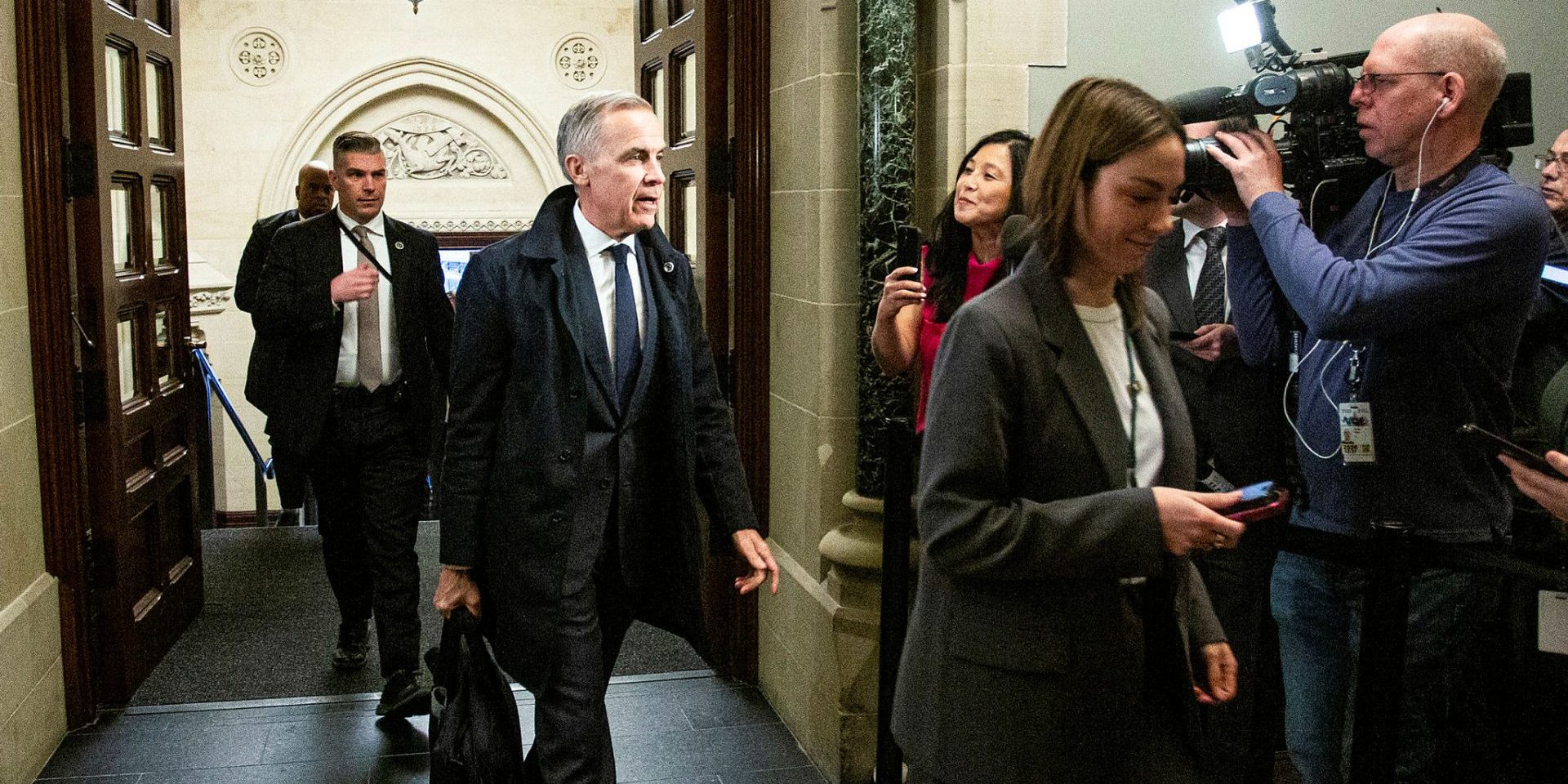
The Hill Times photograph by Andrew Meade
Prime Minister Mark Carney arrives for the Liberal party caucus meeting in West Block on March 11, 2026. 'Anybody who is looking to try and set up a meeting is connecting it to how [their proposal] aligns with the government's seven priorities,' said Robin Guy, vice-president at Crestview Strategy.
The federal Liberals have been in power since 2015, but under new Liberal Prime Minister Mark Carney, the government’s priorities and the best ways to approach them have definitely changed, say lobbyists.
“The transition from [former prime minister Justin] Trudeau to Carney has been getting clients to understand that, despite it still being a Liberal government, it is a very different Liberal government, and that Carney is very much governing from a centre-right [position] versus Trudeau, who was very much on the left side [of the political spectrum],” said Kema Joseph, founder of St-Aude Advocacy, in a March 5 interview.
READ MORE: The Hill Times’ Top 100 Lobbyists in 2026

“For organizations who are working or at least promoting very progressive policies, it’s getting to understand that it’s not that the prime minister or this government don’t care for those types of policies, [but] it just may not be a top priority, or at the top of the agenda like it was with prime minister Trudeau who was very much focused on reconciliation, very much focused on the climate, and … very much focused on tackling anti-Black racism. That was very much at the forefront of a number of initiatives put forward by the Trudeau government,” said Joseph.
That is not to say that the government doesn’t care about initiatives that aren’t solely focused on economic growth, said Joseph, but they should show the government how it will support the government’s priorities.
In a May 2025 mandate letter, Carney laid out seven priorities for all cabinet ministers and departments across the federal government. The priorities include: strengthening economic and security relationships with U.S. and other countries; strengthening the Canadian economy by removing internal trade barriers; investing in Canadian sovereignty and defence; addressing the affordability and housing crisis; and reducing government spending.

“Anybody who is looking to try and set up a meeting is connecting it to how [their proposal] aligns with the government’s seven priorities,” said Robin Guy, vice-president at Crestview Strategy, in a March 5 interview. “This government, in contrast to the last, is focused on discussions about ‘how can capital be deployed? How can we increase investment in the country’ versus the first question that I found under the last government which tended to be more on the net zero environmental side, which obviously is a significant shift.”
This is why lobbyists need to highlight the economic upsides of their proposal regardless of the topic or issue, said Joseph.
“When you are meeting with a staffer who, in the past, would have understood just the moral need for certain initiatives, now it’s more ‘We do understand the moral need, but what is the return investment,’” she said. “If you are going to invest in an initiative or an organization, what will be the direct impact for Canadians, for the economy? It’s making that alignment that has been a bit of a difference of tone between the Trudeau government and the Carney government.”
However, these changes come not only as a result of a change in leadership, but also due to a different world context caused by events outside of Canada, Joseph noted.
“Folks need to also understand the context that those initiatives were put forward,” she said. “A lot of the progressive policies came forward during COVID and so it’s not that this government is not prioritizing [these issues, but] the context that we’re currently in is also impacting the focus of the government.”
“Not only do we have this prime minister who is governing in a very more pragmatic way, more centre-right, but also the context that we are in, essentially our biggest trading partner trying to annex us, but also trying to clearly attack our economy is shifting the priority for this government,” said Joseph, referring to U.S. President Donald Trump imposing massive tariffs on Canada and his rhetoric about Canada becoming a part of the United States.
When presenting policy or funding requests consultants should ensure that they align within the “broader narrative and [the government’s] broader focus,” she said. “The main difference I’ve seen is really the focus on return on investment.”
This change has impacted the best approaches to lobbying the government, said Guy.
“The change between the Trudeau government and where Carney is definitely a government that is more business minded,” he said. “It’s a government which is looking for data. What is the data saying? How does the data [that] you provide to the government support your cause?”
A minority government that is coming into power with the baggage of the previous leadership will want to move quickly on priority issues to show Canadians that they can deliver results, said Guy, noting that “it’s a lot easier to meet with the government on the priorities that they care about.”

Jacob Gorenkoff, founder of Homeward Public Affairs, echoed this sentiment noting that having supporting data can determine the success or failure of a lobbying effort.
“The biggest thing that has stood out to me is the use of much more rigorous data and analytics for decision making,” Gorenkoff wrote in a March 3 emailed response. “From a stakeholder perspective, there’s much more emphasis on coming prepared with a business case for government action than there was previously. Before, you could get by without that until the final stages of securing a win.”
Oksana Kishchuk, vice-president at Abacus Data, provided insight as to the type of data the government is looking to see in meetings. When engaging with the government lobbyists tend to bring forth two types of data: fiscal data and opinion data.
“The first that we’re really seeing is—with fiscal constraints and pressures—that if folks are making trade offs and choices what kind of decisions they would want the government to make in terms of spending,” she said. “The other is political risk and whether or not a decision—a spending decision, a policy decision, whatever the case may be—how much risk it carries, and whether or not it’s something that could impact perceptions of the government.”

Additionally, regardless of the type of data, decision makers place great priority on the timeliness of data, said Kishchuk in a March 9 interview.
“I would say that the volume of work hasn’t necessarily shifted so much [under the Carney government], but what I will say is that the pace of data has shifted,” she said. “The need for timely data has shifted a lot more in terms of the world is just moving a lot faster, and fresher data and getting data back quickly to see how people are reacting to events in real time.”
Another shift from the Trudeau government has been a greater importance of lobbying the federal bureaucracy, according to Gordon Taylor Lee, managing partner at National Public Affairs.

“The shift to a more prominent role being played by the senior levels of the federal public service stands out,” he wrote in a March 11 emailed response. “The executive cadre is being heavily leaned on for both advice and the execution of programs. Any advocacy strategy should be accounting for this shift and it aligns with the overall shift to focusing on economic issues, investment, and market diversification.”
With their increased importance in the decision making process, Lee noted that access to meetings with department heads has significantly increased.
“The accessibility has increased across the board in my view. To this end, senior officials in departments are playing a truly central role in helping to deliver and shape decisions for the government,” he said. “Engagement with private sector leaders across key files – housing, energy, AI, defence – is unquestionably higher than before. Which aligns with the government’s approach to major projects and looking to secure private sector interest and commitments.”
Lee noted that a similar trend can be seen for the government’s approach to engaging with its provincial counterparts.
“It’s truly a 180 degree pivot on the approach from the previous team,” he said.
Carney’s top seven priorities/cabinet ministers’ mandate letters:
- Establishing a new economic and security relationship with the United States, and strengthening our collaboration with reliable trading partners and allies around the world.
- Building one Canadian economy by removing barriers to interprovincial trade, and identifying and expediting nation-building projects that will connect and transform our country.
- Bringing down costs for Canadians and helping them to get ahead.
- Making housing more affordable by unleashing the power of public-private cooperation, catalysing a modern housing industry, and creating new careers in the skilled trades.
- Protecting Canadian sovereignty and keeping Canadians safe by strengthening the Canadian Armed Forces, securing our borders, and reinforcing law enforcement.
- Attracting the best talent in the world to help build our economy, while returning our overall immigration rates to sustainable levels.
- Spending less on government operations so that Canadians can invest more in the people and businesses that will build the strongest economy in the G7.
—SOURCE: Prime Minister of Canada’s website